
The Golden Age of Resonance: How the Abbasid Era Shaped the Modern Oud
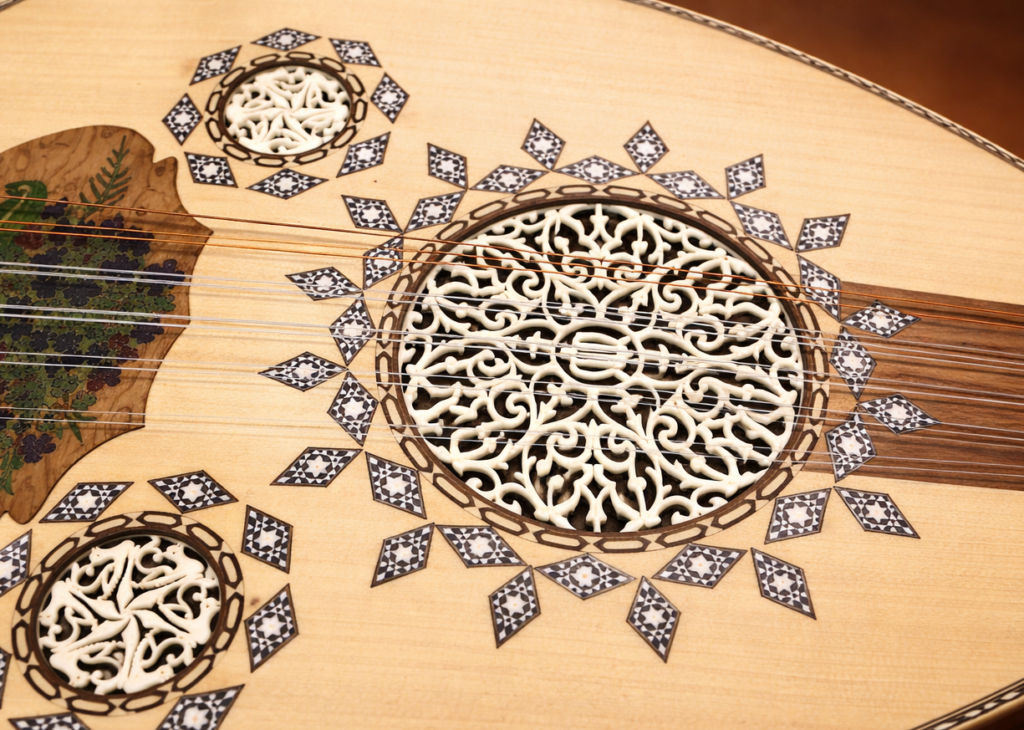
Long before the acoustic guitar took the world stage, the Middle East had already perfected the “King of Instruments.”
The Oud is not just a musical instrument; it is a profound piece of acoustic architecture. While stringed instruments existed in various forms throughout ancient history—such as the Persian Barbat—it was during the intellectual explosion of the Abbasid Caliphate (750–1258 CE) that the Oud was truly revolutionized.
In the courts of Baghdad and later in Andalusia, the brilliant intersection of art, mathematics, and woodworking transformed a simple stringed bowl into the sophisticated, deeply resonant instrument we know today.
Here is how the Abbasid Golden Age permanently shaped the modern Oud.
1. “The Wood”: A Structural Revolution
The very name al-oud translates simply to “the wood.” Before the Abbasid period, many stringed instruments featured soundboards made of stretched animal skin. It was during this golden era that makers fully transitioned to using a wooden soundboard (typically spruce or cedar) and a structurally complex, vaulted wooden bowl.
This engineering upgrade drastically changed the instrument’s tonal qualities. The wooden face allowed for superior acoustic projection, a warmer resonance, and the structural integrity needed to withstand greater string tension. Today, our master luthiers at Abasi Ouds still rely on this exact acoustic physics, hand-selecting naturally air-dried tonewoods to achieve that same legendary resonance.
2. The Addition of the Fifth String
Perhaps the most famous evolution of the Oud is credited to the legendary 9th-century musician and polymath, Ziryab.
Early Ouds traditionally featured four courses of strings, which philosophers of the time associated with the four elements (fire, water, earth, air) and the four humors of the human body. When Ziryab relocated from Baghdad to Cordoba, he made a revolutionary change: he added a fifth string in the center.
Ziryab declared that this fifth string represented the human soul. Practically, it dramatically expanded the instrument’s melodic range and harmonic possibilities, setting the absolute standard for the classical Oud tuning that virtuosos still use today.
3. The Eagle Feather Plectrum (The Risha)
Along with his structural innovations, Ziryab changed how the Oud was played. Before his time, musicians typically plucked the strings using a heavy wooden plectrum. Ziryab introduced the use of a quill made from an eagle’s feather.
This lighter, more flexible material allowed for incredibly rapid, emotive, and nuanced picking without damaging the delicate gut strings. It gave birth to the fluid, sweeping playing style that defines traditional Middle Eastern music. Today, modern players use crafted plastic or horn rishas that specifically mimic the exact flexibility and attack of Ziryab’s eagle feather.
4. Acoustic Mathematics and Proportion
During the Abbasid era, music was considered a branch of mathematics. Legendary philosophers like Al-Kindi and Al-Farabi (who wrote the Kitab al-Musiqa al-Kabir or “Great Book of Music”) studied the Oud not just as artists, but as scientists.
They meticulously calculated the exact mathematical proportions needed for the neck length, the bowl depth, and the placement of the strings to achieve perfect acoustic harmony. They mapped the fretless fingerboard to allow for quarter-tones (microtones), making the Oud the ultimate vehicle for the complex Maqam (melodic mode) system.
A Legacy in Your Hands
When you hold a master-crafted Oud today, you are not just holding a musical instrument. You are holding the direct result of centuries of Abbasid engineering, philosophical thought, and masterful lutherie.
At Abasi Ouds, we are proud to continue this legacy. Our featured artisans bridge ancient tradition with modern lutherie, building exquisite instruments that honor the profound history of the wood.